

No Picnic on Mount Kenya: The Daring Escape of Felice Benuzzi
Updated: Aug 4
Introduction: The Ambassador from the Peaks
In the 1970s, a brilliant, sharp-eyed diplomat served as the Italian Ambassador to Uruguay. His name was Felice Benuzzi. To the international diplomatic corps, he was a distinguished statesman who had managed volatile geopolitical crises in West Berlin during the height of the Cold War. Yet, beneath his tailored suits and formal protocol lay the soul of a man who, decades earlier, had looked absolute despair in the eye and defeated it with an act of pure, poetic madness. His journey to the peak of international diplomacy did not begin in a university hall, but in the dead of an African night, breaking out of a concentration camp.
Chapter 1: The Breach at Midnight
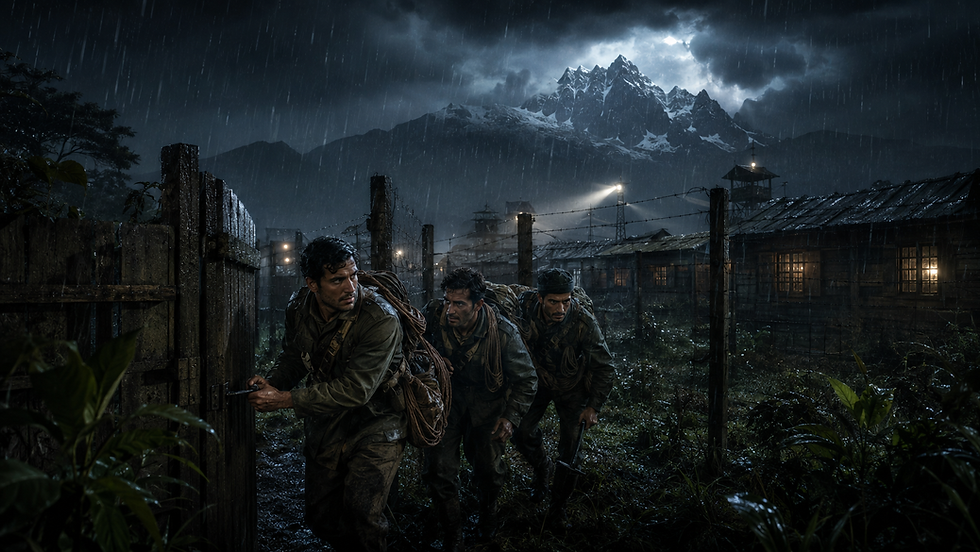
The night of January 24, 1943, was pitch black. At exactly 21:15, under the cover of a sudden, heavy equatorial downpour, three silhouettes glided past the wooden barracks of British POW Camp 354 in Nanyuki. The rain muffled their footsteps and blinded the searchlights on the watchtowers.
They did not cut the wires. Instead, they approached the main wooden gate of the vegetable garden compound. For months, they had observed the camp locksmith. Armed with a crude, hand-filed key made from a scrap piece of iron, Felice Benuzzi stepped forward. He inserted the key. With a faint, metallic click, the lock gave way.
Benuzzi, Dr. Giovanni Balletto, and Vincenzo Barsotti slipped through the opening and closed the gate behind them. They were out. Behind them lay the camp; ahead of them lay the unknown.
Chapter 2: Navigating the Equatorial Wilds
The immediate challenge was survival in one of the most hostile environments on Earth: the East African savanna and the dense jungle surrounding the base of Mount Kenya.
They had no military compasses, no professional gear, and no reliable maps. To find their way through the labyrinth of giant bamboo forests and thick afro-alpine moorlands, they relied entirely on basic celestial navigation when the clouds cleared, and a stroke of pure human genius. Benuzzi had hand-drawn a crude topographical sketch by meticulously copying the tiny, stylized profile of Mount Kenya printed on the label of an Oxo brand canned meat box—a remnant of their meager rations.
Moving in total silence, they navigated by tracking the mountain’s dark silhouette against the stars. They spent their nights dodging the unpredictable dangers of the wild: stepping around fresh elephant tracks, freezing in place at the distant roar of lions, and narrowly avoiding aggressive rhinoceroses in the dense undergrowth.
Chapter 3: The Prisoner and His Mountain
Who was the mastermind behind this impossible flight? Felice Benuzzi, born in Vienna in 1910 and raised in Trieste, was an expert alpinist who had conquered the vertical rock faces of the Dolomites. A lawyer and a diplomat, he had moved to Addis Ababa to protect his German Jewish wife, Fanny, from Nazi-Fascist persecution.
But in 1941, the British Army crushed the Italian presence in East Africa. Benuzzi was captured and dragged to the Nanyuki camp.
This camp was an psychological furnace where Benuzzi would be trapped for five long, agonizing years (from May 1941 to August 1946). The camp sat at an altitude of 6,500 feet. The climate was brutal: the corrugated zinc barracks became suffocating ovens under the daytime sun, only to freeze the inmates at night, leaving them to shiver on straw mattresses with just two rough blankets. Starved on a monotonous diet of "Posho" (a flavorless white corn porridge) and fagioli, the prisoners fell victim to "barbed-wire disease"—a deep, paralyzing depression.
Every morning, however, Benuzzi looked past the wire and saw the glittering glaciers of Mount Kenya. He realized that to save his mind from rotting, he had to conquer that peak. After eight months of secret preparation—forging ice axes from stolen hammers and braiding climbing ropes from hemp supply sacks—he broke out.
After 17 days of extreme physical torment, dodging blizzards with frozen fingers and makeshift clothes, Benuzzi and Balletto bypassed the highest peak due to a storm but successfully conquered Point Lenana (16,355 feet) on February 6, 1943. They planted a homemade Italian tricolor flag on the equator, proving that their spirit was unbroken.
Chapter 4: The Theatrical Return
They had won their spiritual war, but thousands of miles of desert separated them from safety. Starving, freezing, and exhausted, they chose a final act of supreme dignity: they went back.
On February 10, 1943, the three men quietly slipped back through the same garden gate they had unlocked weeks prior. They did not look like broken fugitives. They marched into the compound, thoroughly washed themselves, shaved, and put on their cleanest, patched-up military uniforms.
With absolute military posture, they marched straight into the office of the British camp commandant. The captain looked up from his desk, utterly speechless. The three missing prisoners stood before him, saluted, and calmly reported back for internment.
Chapter 5: The Fate of the 55,000
Benuzzi’s camp was just one cog in a massive British colonial machine. Across Kenya, the British held over 55,000 Italian prisoners of war crammed into 11 high-security macro-complexes like Gilgil, Nanyuki, and Ndarugu. This massive Italian population actually outnumbered the entire white British civilian population residing in Kenya at the time.
Even after Italy signed the armistice in September 1943 and the war ended in 1945, the British refused to release them. The prisoners were treated as a vital, unpaid labor force. For years, these 55,000 Italians were forced to build Kenya's modern infrastructure, clearing tropical forests, laying down critical railway networks, and carving the strategic mountain highways that are still used today.
Chapter 6: The Ultimate Gift of Respect
Yet, Benuzzi’s exploit changed the atmosphere inside Camp 354. The British officers and guards, being traditional Anglo-Saxon sportsmen, were deeply profoundly moved by the sheer chivalry, honesty, and athletic audacity of the climb.
Instead of throwing Benuzzi into the standard 28 days of brutal solitary confinement for wartime evasion, the commandant reduced the sentence to just 7 days in the cells, granting the men the full honors of war.
As the long post-war months dragged on, the British guards did something extraordinary. Recognizing Benuzzi's literary talent and his incredible story, they bypassed strict prison protocols and presented him with a gift: stacks of paper, bottles of ink, and a typewriter. Sitting in his wooden barrack, surrounded by barbed wire, Benuzzi typed out his adventure directly in English. When he finally boarded the repatriation ship to Naples in August 1946, his rucksack held no colonial riches—only the typed pages that would soon introduce the world to No Picnic on Mount Kenya.


Comments